
 Farmers across the Northern Tablelands are now better prepared for future climate extremes, thanks to the completion of the Drought Resilient Pasture Landscapes (DRPL) project.
Led by the University of New England (UNE) in partnership with Southern New England Landcare (SNEL) and GLENRAC Inc, the DRPL project has worked with local farmers using an on-farm coaching program aimed to help them better navigate climate variability and drought conditions.
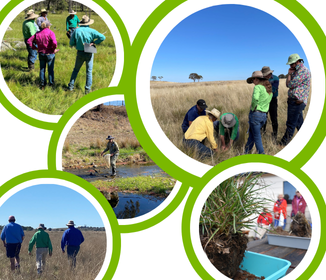
One of the biggest keys to the success was the hands-on, collaborative, on-farm approach to learning.
“By visiting various properties and assessing different pasture types and management practices, participants deepened their knowledge and confidence while strengthening their local networks,” says project lead, Professor Lewis Kahn.
“Revisiting properties over the course of the project also allowed farmers to see for themselves the influence of different management practices in conjunction with climate variables and the changes that occurred as a result of the project learnings.”
Over the past 18 months, participants have increased their skills, knowledge and confidence with pasture assessment, and are now able to use climate forecasts to assist in formulating feed budgets for determining stocking rates in advance.
“When the project began, less than half of the participants used climate forecasts when planning stocking rates and this increased to 94 percent at the end of the project,” says Professor Kahn.
“Planning stocking rates enables farmers to make informed decisions to ensure targeted levels of pasture herbage mass are achieved. Making these management changes provides key benefits in pasture growth, livestock productivity, reduced rainfall runoff and reduced erosion.”
Participants also gained confidence in estimating herbage mass, which has helped to build long-term habits that will enable them to make decisions early to alleviate pressures triggered by climate variability.
“With repetition and support, farmers became more confident at accurately estimating ground cover and green content during the on-farm coaching sessions,” says Professor Kahn.
“Assessing herbage mass accurately is the key learning outcome from the DRPL project and the number farmers estimating herbage mass correctly increased from 30 to 91 percent.”
The link between healthy waterways and land management, and how to use online tools to increase resilience were other key learnings.
“Farmers were introduced to the Ag360 online tool and established their accounts, including farm records, so they could benefit from forecasts of soil moisture, pasture availability and livestock productivity six months ahead.”
As climate variability is expected to increase, Professor Kahn says it has never been more important for farmers to ensure their enterprise can withstand challenges, as well as reap the benefits during the good times.
Because of this, the resources and findings developed over the course of the project have been made available via the GLENRAC and SNEL websites for anyone to access.
The website contains water quality test results from the project's eight sites, soil organic carbon results from 140 on farm tests, a photo library to evaluate herbage mass, written and video case studies, a how-to guide for pasture assessment, and a coaching manual for knowledge sharing.
This project received funding from the Australian Government’s Future Drought Fund, and is a partnership between UNE, GLENRAC Inc., and Southern New England Landcare Ltd.
Release: 2024